
Business Process Automation – A Practical Guide for Companies
Business process automation removes chaos and bottlenecks. Learn which processes to automate first, which tools to pick and how to measure your return.
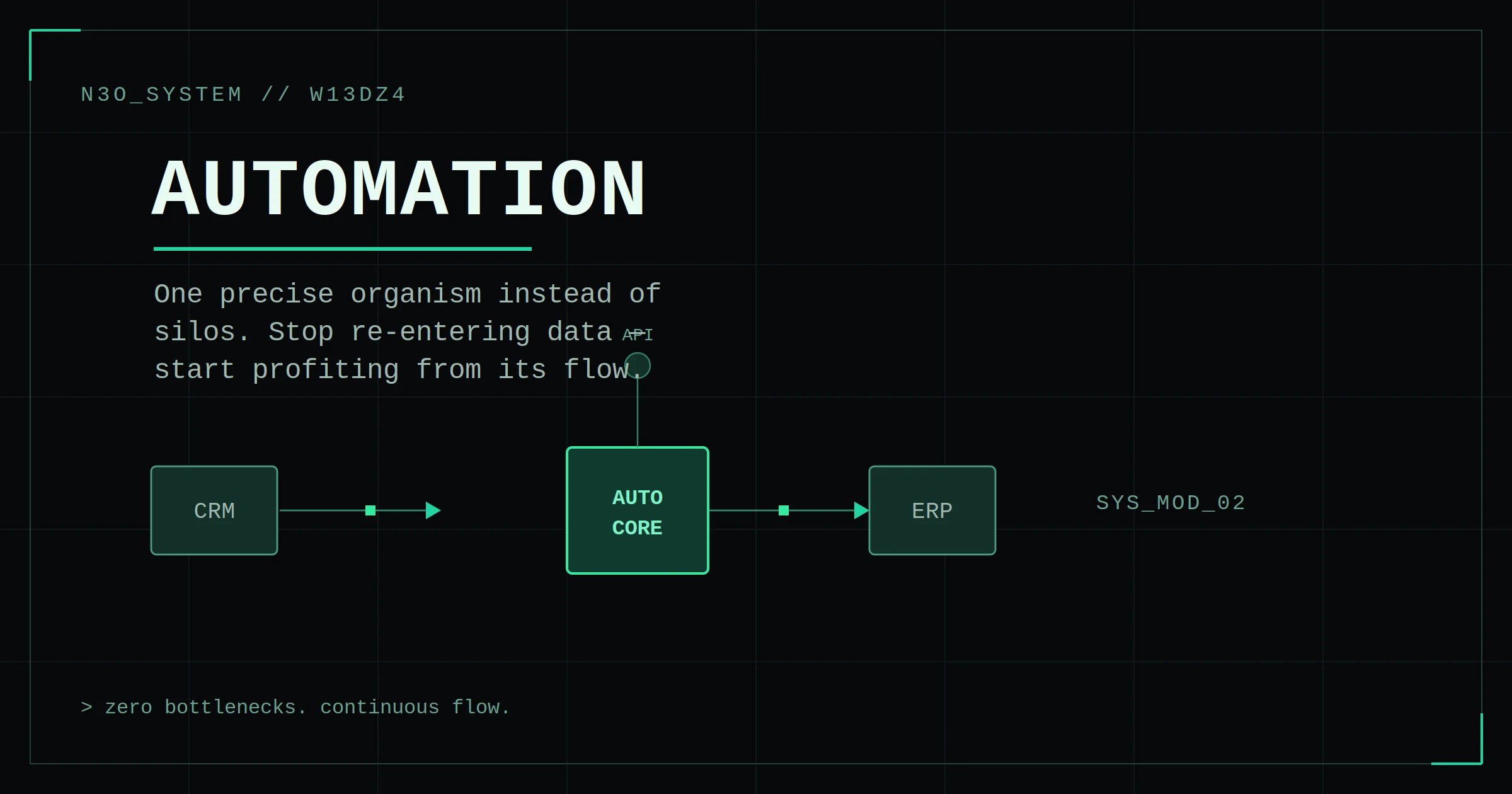
Business Process Automation — A Guide for Companies That Want to Reclaim Time
In most companies, the most valuable resource — the time of skilled people — leaks away through repetitive tasks: manually re-entering data between systems, copying information from emails into the CRM, generating the same reports every week. Business process automation solves this problem at its source. In this guide we show which processes to automate first, which tools to choose and how to avoid the most common mistakes.
What is business process automation
Business process automation (BPA) is the use of technology to perform repetitive tasks and entire workflows with no human involvement, or with minimal involvement. It isn't about isolated "macros" — it's about connecting siloed systems into one coherent organism where data flows automatically: from a customer inquiry, through CRM and ERP, all the way to the invoice and the report.
The result? Instead of wasting time manually moving data, the company starts earning from its flow.
Which processes to automate first
Not everything is worth automating immediately. The best results come from starting with processes that are simultaneously repetitive, time-consuming and rules-based. Most often these are:
Document and invoice workflows — reading, classifying and entering data into the system.
Data synchronization between systems — CRM, ERP, marketing and accounting tools no longer require manual re-entry.
Inquiry and lead handling — automatic qualification, assignment and first contact.
Reporting — recurring reports generated and distributed without human input.
Internal communication and notifications — automatic alerts on critical events.
A good practice is a process map with an estimate of how many hours per month each process consumes and how error-prone it is. That map dictates the order of implementation.
Tools: low-code or a custom solution?
In automation there's no single correct tool — there's the tool matched to the scale and complexity of the process.
Low-code platforms (e.g. Make.com, n8n) work well for quickly connecting popular apps and simpler workflows. They let you deploy automation cheaply and fast, without writing code from scratch.
Custom solutions are essential where processes are complex, volume is high and security and performance requirements are demanding. A custom system gives full control, scalability and independence — free of the limits imposed by off-the-shelf platforms.
AI-driven automation is the next level: where rules aren't enough (e.g. interpreting content, making decisions in ambiguous cases), AI agents step in. Read more in our article on AI agents for business.
In practice, the best deployments combine these layers: low-code for fast integrations, custom code for critical processes, AI for decisions.
How to measure the return on automation
It's worth calculating the return on automation across three categories:
Recovered time — the number of work hours freed from routine tasks × the cost of an employee hour.
Error reduction — the cost of mistakes (corrections, complaints, delays) that disappear after automation.
Scalability — the ability to handle greater volume without a proportional rise in cost and headcount.
A well-chosen process can pay back the implementation cost within a few months and then generate savings every month after that.
The most common automation mistakes
Automating chaos — automating a poorly designed process only entrenches the problem. Fix it first, then automate.
Starting too broad — trying to automate everything at once leads to getting stuck. Better to deploy one process and prove the result.
No process owner — automation without someone responsible for maintaining it quickly goes stale.
Ignoring integration — the value of automation grows when systems "talk" to each other rather than operating in silos.
How to get started
Effective implementation starts with a process audit, not with buying a tool. At N3O System we map your workflows, pinpoint the highest-return processes, design the architecture and deploy it step by step — connecting CRM, ERP and communication into one precise system.
Want to eliminate bottlenecks and recover dozens of hours a month? Write to us at systems@n3osystem.io or explore our Automation module.